
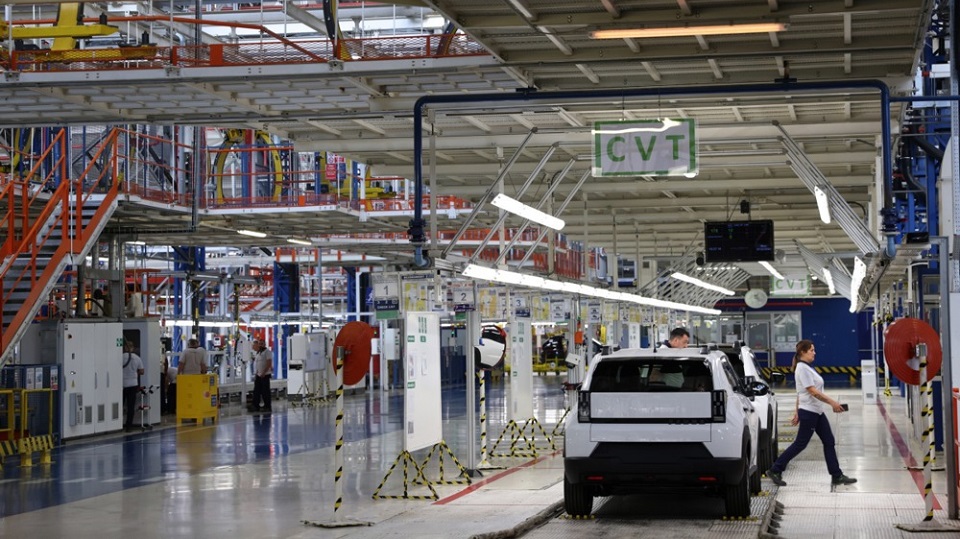
Major European Automakers Unite to Push ‘Made in Europe’ Manufacturing Initiative
Three of Europe’s largest automotive manufacturers — Stellantis, Volkswagen, and Renault — have joined forces to advocate for a sweeping new industrial policy that would fundamentally reshape the continent’s automotive supply chain. The ambitious proposal calls for 70% of vehicles sold in the European Union to contain at least 70% locally-sourced components, marking a significant push toward automotive self-sufficiency amid growing global trade tensions and competitive pressures from Asian manufacturers.
The coalition’s proposal, dubbed the ‘Made in Europe’ plan, represents a strategic response to multiple challenges facing the European automotive sector. With Chinese electric vehicle manufacturers rapidly expanding their market share through competitive pricing and advanced technology, European automakers have found themselves increasingly vulnerable to foreign competition. The initiative aims to strengthen domestic production capabilities while simultaneously addressing concerns about job preservation in an industry that employs millions of workers across the continent.
The automotive industry has long served as the backbone of European manufacturing, contributing approximately 7% of the EU’s total GDP and directly employing over 2.5 million people in production alone. When including the broader supply chain — parts suppliers, dealerships, and service centers — the sector supports nearly 13 million jobs across the 27-member bloc. However, the industry has faced unprecedented disruption in recent years, from semiconductor shortages that crippled production during the pandemic to the accelerating transition toward electric vehicles that threatens to upend traditional manufacturing processes and supply relationships.
Industry analysts suggest that the 70-70 proposal reflects growing anxiety among European automakers about their competitive position in the global market. The transition to electric vehicles has opened the door for new competitors, particularly from China, where manufacturers like BYD and NIO have developed cost-effective production methods and secured dominant positions in battery technology supply chains. Currently, China controls approximately 75% of global lithium-ion battery cell production, a critical component in electric vehicles that European manufacturers have struggled to produce at competitive scales.
The push for localized content requirements also echoes similar policies implemented in other major markets. The United States, through its Inflation Reduction Act, has established strict local content requirements for electric vehicles to qualify for consumer tax credits, effectively incentivizing domestic production and supply chain development. This approach has already prompted several European and Asian automakers to announce significant investments in North American manufacturing facilities, demonstrating how policy can influence industrial geography.
Critics of the proposal, however, warn that such stringent local content requirements could backfire. Some economists argue that forcing high levels of domestic sourcing could increase production costs, ultimately making European vehicles more expensive for consumers and less competitive in export markets. There are also concerns about potential trade tensions, as such policies could be viewed by international partners as protectionist measures that violate World Trade Organization principles. The European Commission will need to carefully balance industrial policy goals with trade obligations and consumer interests.
The timing of this initiative coincides with broader discussions about European strategic autonomy across multiple sectors, from semiconductors to renewable energy. The COVID-19 pandemic exposed the fragility of global supply chains, prompting policymakers throughout Europe to reconsider the wisdom of heavy reliance on distant suppliers for critical goods. The automotive sector, with its complex web of international suppliers and just-in-time manufacturing processes, proved particularly vulnerable to these disruptions. As Europe navigates the twin transitions of electrification and digitalization in transportation, the ‘Made in Europe’ proposal represents a significant attempt to ensure that the continent remains a major player in the future of mobility rather than becoming dependent on foreign technology and manufacturing capacity.